



Why Do Hand Towels Go Hard and Scratchy After Washing?
Posted by Talha Nisar on 13th Jun 2026
The towels felt soft when you bought them. Three months later they're rough enough to sand a shelf. You haven't changed your washing routine. Nothing obvious has gone wrong. So what happened?
The short answer is that most hand towels are made from open-end spun cotton — a production method that creates a coarser yarn with loose fibre ends. Those loose ends break away with every wash cycle. The pile thins, the texture coarsens, and by the time the towel feels rough, the damage is mostly structural. You can slow the decline with better washing habits, but if the construction was wrong to start with, you're managing a losing battle rather than solving the problem.
This article covers what actually causes hand towels to go hard, what you can do about it, and — most importantly — what to look for when buying towels that won't repeat the problem.
The real cause: yarn construction, not your washing machine
Most hand towel guides blame rough towels on fabric softener, high temperatures, or hard water. All of these accelerate the problem. None of them cause it.
The cause is open-end spinning. Cotton fibre can be spun into yarn two ways. Open-end spinning uses air pressure to spin fibres into yarn quickly and cheaply. The result is a coarser yarn where the fibre ends aren't fully locked into the structure — they sit loosely at the surface. Ring-spun spinning twists the fibres together under mechanical tension before weaving. The yarn is tighter, smoother, and the fibres are more securely bound.
When an open-end yarn towel goes through a wash cycle, those loose surface fibres break away. The first few washes might not be noticeable. By wash fifteen, the pile has visibly thinned. By wash thirty, the texture has coarsened enough that the towel feels rough against skin. This isn't wear — it's the yarn structure breaking down from the outside in.
A ring-spun cotton hand towel at 400 GSM will outlast an open-end cotton towel at 600 GSM. The higher GSM on the open-end towel just means there's more fibre to lose before it goes thin. It still goes thin. Browse ring-spun cotton hand towels by GSM
What fabric softener actually does
Fabric softener coats the cotton fibres with a thin layer of lubricant — that's what produces the soft feel straight out of the tumble dryer. The problem is that the same coating reduces the fibre's ability to absorb moisture. Used occasionally it's not catastrophic. Used every wash, it builds up on the pile, reduces absorbency, and can make the towel feel waxy rather than soft after a few months.
More importantly, fabric softener doesn't reverse the structural damage from open-end yarn shedding. It masks it temporarily. The towel feels softer on Tuesday; by Friday it's rough again because the underlying pile has thinned further.
If you want to soften towels without fabric softener, white distilled vinegar in the rinse cycle strips mineral buildup and softens fibres without coating them. Half a cup in the fabric softener drawer, not mixed with detergent. It doesn't leave a vinegar smell once the towel is dry.
What washing temperature does to towel pile
Cotton terrycloth is stable up to 60°C — that's why ring-spun institutional towels are rated for commercial washing at that temperature. Above 60°C repeatedly, even ring-spun cotton starts to break down faster than normal. The fibres contract and expand with each thermal cycle, and over hundreds of washes this stresses the pile structure.
For home bathroom hand towels, 40°C is sufficient for hygiene and significantly gentler on the pile. 60°C is appropriate if someone in the household is immunocompromised or if the towel is being used in a care or clinical setting. Washing cotton hand towels at 90°C at home shortens their lifespan substantially without meaningful hygiene benefit over 60°C with a good detergent.
Open-end spun cotton is more sensitive to temperature than ring-spun because the loose fibre ends are already partially detached. High temperature wash cycles accelerate the shedding that was already happening. This is why cheap hand towels from supermarkets go rough so quickly — they're open-end construction being washed at 60°C by people who assume that's the right temperature for towels.
Hard water and mineral buildup
In hard water areas — most of England, particularly the south and east — mineral deposits from calcium and magnesium build up in cotton fibres over time. This is a separate issue from yarn construction and it does cause stiffness, even in well-made towels.
The signs are distinct: hard water stiffness tends to be uniform across the whole towel, and the towel feels slightly crispy rather than rough-textured. Construction-related roughness is concentrated in the pile — the towel feels coarser to the touch but isn't necessarily stiff.
Tumble drying on low heat breaks up mineral deposits better than line drying in hard water areas — the mechanical action of the drum does some of the work. White vinegar in the rinse cycle (as above) helps dissolve calcium buildup. A water softener on the washing machine removes the problem at source but is a larger investment.
Two UK-specific remedies worth knowing about: soda crystals and baking soda. A hot cottons wash with soda crystals only — no detergent, no fabric softener — strips both mineral and detergent buildup from fibres at once. Use roughly 500g in a 60°C wash. It sounds aggressive but soda crystals are safe on cotton and significantly more effective than vinegar alone on heavy buildup. The baking soda method works similarly for lighter buildup: half a cup added to a normal wash cycle alongside a reduced amount of detergent neutralises mineral deposits and softens the fibre without the coating effect of fabric softener.
Tumble drying versus line drying
Line drying in moving air is fine for cotton hand towels and preserves fibre structure better than tumble drying. The problem is line drying in still air — particularly indoors — where the fibres dry flat and stiff rather than being lifted by air movement. The result is a board-stiff towel that feels rough until it's been used a few times and the pile softens with handling.
Tumble drying on low heat prevents this by keeping the pile fibres moving as they dry, which keeps them lifted and soft. High heat tumble drying speeds up drying but stresses the fibre structure — the same thermal cycling issue as high-temperature washing, compounded. If you tumble dry, use the lowest heat setting that dries the towel fully.
A short tumble dry on low followed by line finishing — five to ten minutes in the drum then hung to finish drying — gives the best of both. The pile lifts in the drum; the fibres finish drying without further heat stress.
One UK-specific problem worth addressing directly: radiator drying. In winter when outdoor drying isn't practical and tumble dryers aren't available, most UK households dry towels over a radiator. The heat speeds up drying but the still air around the radiator means fibres dry flat and rigid rather than lifted. The result is the characteristic crunchy texture that cleaning forums discuss constantly. If radiator drying is unavoidable, shake the towel vigorously before hanging it, reposition it partway through drying to expose the other side, and shake again before folding. Even five minutes in a tumble dryer on low to finish off a radiator-dried towel makes a significant difference to final softness. Front loader washing machines — the standard in UK homes — can contribute to stiffness if the load is too large: towels need room to move freely through the water to rinse properly. Two or three towels maximum per front loader cycle for best results.
What to buy to avoid the problem entirely
The only permanent fix for hand towels that go rough is to replace open-end spun cotton with ring-spun cotton. Everything else is management.
For home bathroom use, 500–600 GSM ring-spun cotton holds its pile through years of regular washing at 40°C. The 600 GSM double yarn construction — two yarns twisted together rather than one — is the most durable option at that weight range. The pile is denser from the start and the fibre structure holds under repeated washing.
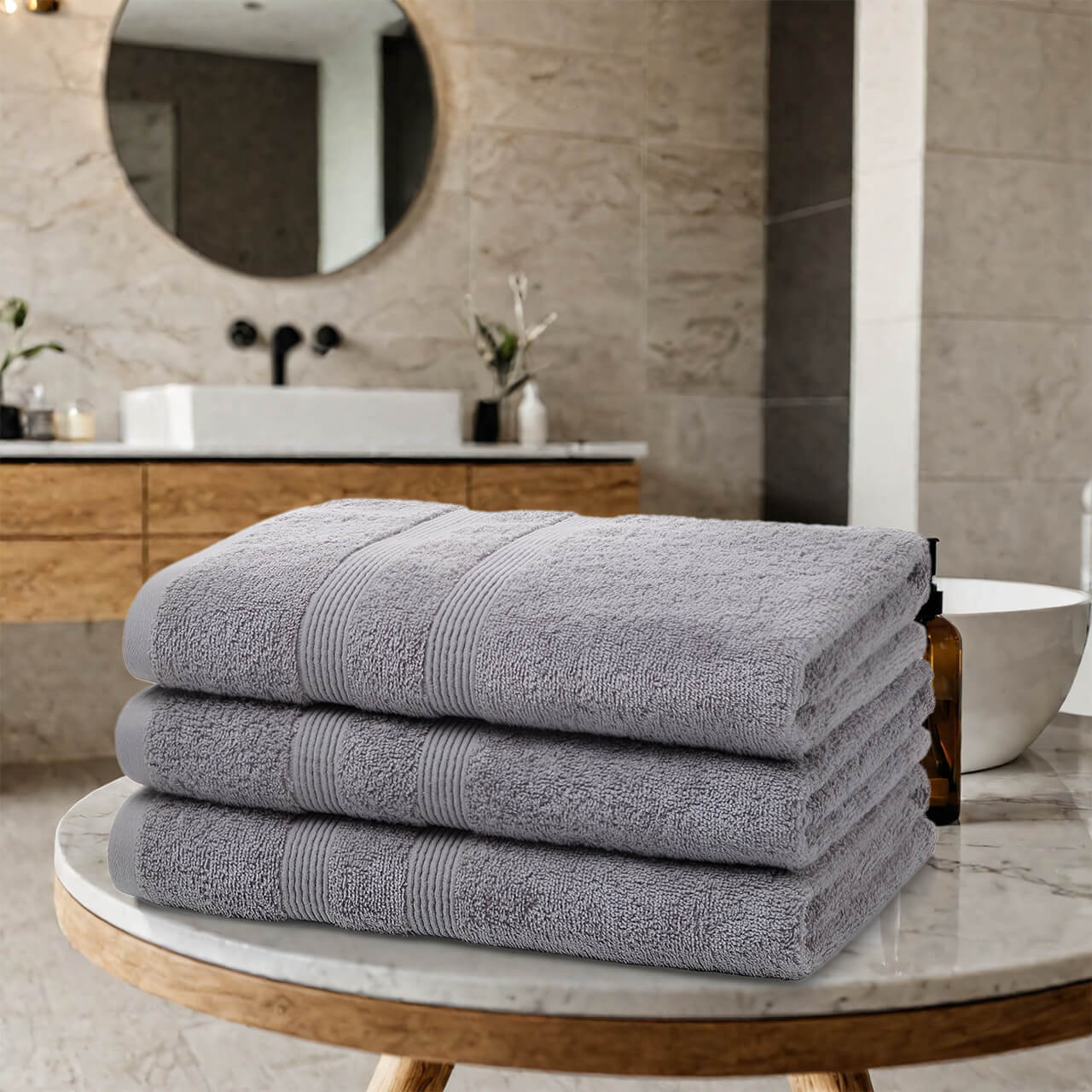
500 GSM Royal Egyptian — ring-spun cotton, the most re-ordered weight for home bathroom use
For sensitive skin where roughness is a particular problem, the 700 GSM GOTS certified bamboo hand towels are worth considering. Bamboo fibre is smooth at fibre level — not just pile level — which means it doesn't develop the rough texture that cotton can even when the pile stays intact. It's naturally antibacterial and GOTS certified for organic fibres and responsible manufacturing.

700 GSM Bamboo — GOTS certified, smooth at fibre level, naturally antibacterial
For hotels, care homes, or gyms where towels are being washed at 60°C or above: 400–450 GSM ring-spun institutional cotton. Faster drying, rated for commercial temperatures, and won't shed the way open-end cotton does at those temperatures. The replacement cost over twelve months is lower even though the per-unit cost at purchase is similar. Browse 400 GSM Institutional Hand Towels
No minimum order on any of these. Free delivery over £35. If you want to talk through which construction suits your wash cycle before ordering, call 01204 455755. Browse all hand towels
FAQs
Why do my hand towels feel rough after washing?
Almost always yarn construction. Open-end spun cotton — used in most budget hand towels — has loose fibre ends that break away during washing. After ten to fifteen cycles the pile thins and the texture coarsens. Washing at high temperatures above 60°C, using fabric softener regularly, and tumble drying on high heat all accelerate the problem — but if the towel went rough within a few months, the yarn type was the issue from the start, not the washing routine.
Can you make hard hand towels soft again?
You can partially restore softness, but not reverse structural pile damage. For mineral buildup in hard water areas: wash with half a cup of white distilled vinegar in the rinse cycle with no fabric softener, or run a hot cottons wash with soda crystals only. For general stiffness: a short tumble dry on low lifts the pile fibres. For towels that have gone rough due to fibre shedding, the pile has already thinned. Softening treatments mask this temporarily but do not rebuild the pile structure.
How do you soften hand towels without a tumble dryer?
Line dry outside in moving air — wind does the same job as a tumble dryer's mechanical action for lifting pile fibres, even in winter as long as it's breezy. Shake the towel firmly before hanging and again when bringing it in. For indoor drying without a tumble dryer, a soda crystals hot wash first strips the mineral and detergent buildup that causes stiffness — then hang over a heated airer rather than a cold radiator in still air. Shaking towels repeatedly during the drying process prevents the fibres from drying flat and makes a genuine difference to final softness.
Does fabric softener make towels rough?
Not directly, but regular use reduces absorbency and can leave a waxy buildup that changes the texture. Fabric softener is often used to compensate for towels that have already gone rough due to poor construction — it provides temporary softness without fixing the underlying problem. Use it occasionally rather than every wash, and skip it entirely if absorbency has dropped noticeably.
What is the best way to wash hand towels to keep them soft?
40°C for home bathroom towels — hot enough for hygiene, gentle enough on the pile. No fabric softener every wash. Tumble dry on low or line dry in moving air, not still indoor air. Shake out before hanging. Avoid overcrowding the washing machine — two or three towels maximum per front loader cycle so they rinse properly. For ring-spun cotton towels this routine will keep them soft and absorbent for two to three years. For open-end cotton towels, it slows the decline but doesn't prevent it.
How do hotels keep their towels so soft?
Three things: ring-spun cotton construction, correct wash temperature, and no fabric softener. Hotel laundries wash at 60°C with a measured amount of commercial detergent — not domestic quantities which tend to be too high. They tumble dry at low-to-medium heat and don't use fabric softener, which reduces absorbency over time. The towels themselves are typically 400–500 GSM ring-spun cotton — lighter than domestic towels, which means they dry faster and don't hold moisture between uses. The softness comes from the construction holding up through hundreds of wash cycles, not from any treatment applied after washing. Read: Best hand towels for bathrooms UK — GSM guide
Why do my towels feel like sandpaper after washing?
Sandpaper texture specifically — rather than just stiffness — is almost always open-end spun cotton that has shed enough pile fibre to expose the coarser underlying yarn. Stiffness from mineral buildup or detergent residue is recoverable with a vinegar or soda crystal wash. Sandpaper texture from pile loss is structural — the fibre is gone and won't come back. The remedy is replacement with ring-spun cotton, not another softening treatment. If the towel went sandpaper-rough within a few months of purchase, the construction was open-end from the start. Browse ring-spun cotton hand towels
How long should hand towels last before going rough?
A ring-spun cotton hand towel at 500–600 GSM, washed at 40°C and dried correctly, should maintain softness and absorbency for two to three years in a home bathroom. Open-end cotton at similar GSM typically starts to coarsen noticeably within three to six months of regular use. The construction difference is that significant.
Related reading: Best hand towels UK — what actually makes one last · Hand towel sizes UK — dimensions and GSM guide · Best hand towels for bathrooms UK · Browse hand towels