



What is Turkish Cotton? Why It Suits Bathrobes
Posted by Talha Nisar on 8th Oct 2026
What is Turkish Cotton? And Why Does it Make Better Bathrobes?
A Turkish cotton bathrobe costs more than a plain terry one, so it is fair to ask whether you are paying for the fibre or only for the words on the label.
Turkish cotton is long-staple cotton grown along Turkey's Aegean coast. The longer fibres leave fewer loose ends in the weave, so a towelling robe holds its pile and softness for longer. The trade-off is weight: our 450 GSM Turkish cotton robe is a heavy one.

What makes Turkish cotton different
Most everyday cotton is upland cotton, which has a short fibre. When short fibres are spun into yarn, plenty of loose ends stick out of the weave. In a towelling robe those ends are what come away as fluff and slowly thin the loops.
Turkish cotton has a longer staple. Each strand runs further before it ends, so fewer ends work free. That is why a Turkish cotton towelling robe tends to hold its pile and stay soft through repeated washing instead of matting down.
What a Turkish cotton bathrobe feels like
Soft, with a dense terry pile. You will read elsewhere that Turkish cotton robes are light, and some are, especially waffle weaves. Ours is terry towelling at 450 GSM. That makes it a denser fabric than our 400 GSM standard terry robe, and several customers describe it as thick and heavy.
If you like a dressing gown you can feel on your shoulders, that suits you. If you want something airy, a waffle robe is the better pick.
Does Turkish cotton get softer with washing?
Cotton terry feels softer after the first wash or two, once the manufacturing residue rinses out. After that, the long fibre does a different job. It slows the matting and thinning that make lower-grade robes feel rougher in their second year.
We would not promise that a Turkish cotton robe keeps getting softer for ever. A fair expectation is that it stays soft instead of turning scratchy.
Is Turkish cotton more absorbent?
A robe absorbs because of its terry loops, not because of where the cotton grew. What the long fibres add is staying power: the loops stay upright and intact after washing, so the robe keeps absorbing as it ages.
Some customers say theirs dries them quickly and call it very absorbent. We have no lab figure to quote, so read it as a robe that absorbs the way good terry should and keeps doing so.
Turkish cotton robe vs standard terry robe
Our Turkish cotton robe and our standard terry robe differ in four ways.
| Feature | Turkish cotton robe | Standard terry robe |
|---|---|---|
| Cotton | 100% Turkish cotton, long staple | Cotton terry |
| Weight | 450 GSM | 400 GSM |
| Fit | True XL, 125cm shoulder to hem | One-size fit |
| Colour | White only | Wider colour range |
Turkish cotton vs Egyptian cotton
Both are long-staple cottons, and both beat everyday upland cotton for softness and strength. Egyptian cotton is grown in the Nile Valley and is often described as the smoother of the two. Sources disagree on which absorbs more.
In a finished robe the weight, weave and cut matter more than the country. Compare the GSM and the measurements before you compare the name on the label.
Is a Turkish cotton robe worth the extra?
It comes down to fit, weight and colour. Choose the Turkish cotton terry towelling bath robe if you are tall or broad and have been caught out by dressing gowns sold as one size. It is cut to true XL, 125cm from shoulder to hem and 150cm across the full width. Some shorter customers, at 5ft 2 and 5ft 3, say it falls close to the ankle, so expect a long robe if you are small.
Choose the standard terry towelling bath robe if you want more colours or a lighter 400 GSM weight.
For hotels and spas, the Turkish cotton robe is one fixed cut in one colour, sold singly or in packs of 5 and 10, so every hook carries the same SKU.
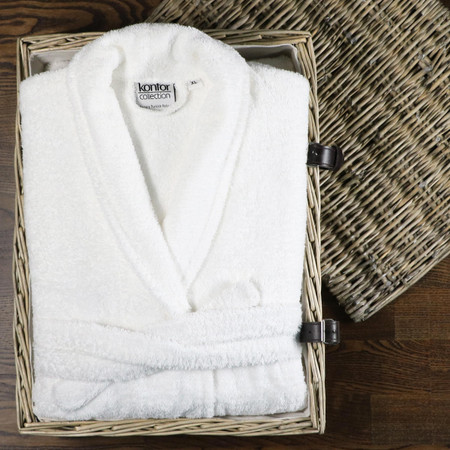
How to wash a Turkish cotton bathrobe
Wash it once before the first wear. Some customers tumble dried theirs first to clear the excess fluff and were happy with how soft it came out.
After that, wash at 40°C or cooler. The robe is white, so keep it away from darker items to stop it greying. Skip fabric softener, which coats the cotton loops and cuts absorbency over time, and avoid bleach on repeated washes because it weakens the fibres. Tumble dry on low or air dry, and avoid over-drying, which leaves towelling feeling stiff.
The full routine, with stain and fluffing tips, is in our wash and care guide. To compare weights, cuts and colours before you choose, browse the full range of dressing gowns and bathrobes.
FAQs
Q: Is Turkish cotton good for bathrobes?
It suits a robe you plan to wash often. Turkish cotton has long fibres, so fewer loose ends work free in the wash and the loops hold their shape. It is not automatically the lightest or lowest-priced option, so check the GSM and the fit as well as the fabric.
Q: What is the difference between Turkish cotton and Egyptian cotton?
Both are long-staple cottons, and both beat everyday upland cotton for softness and strength. Egyptian cotton is grown in the Nile Valley and is often described as the smoother of the two, while Turkish cotton comes from the Aegean coast. Sources disagree on which absorbs more. In a finished robe the weight, weave and cut tell you more than the country does, so compare the GSM and measurements before you compare the origin.
Q: Is a Turkish cotton robe the same as a waffle robe?
No. Turkish cotton is the fibre, while waffle and terry are weaves. Ours is terry towelling.
Q: Do I need to wash a Turkish cotton robe before wearing it?
Wash it once first. Some customers tumble dried theirs before the first wear to clear excess fluff, and they were happy with how soft it came out. Use 40°C or cooler, keep it away from darker items, and tumble dry on low.
Q: Is a Turkish cotton robe heavy?
At 450 GSM, yes. The fabric is denser than our 400 GSM standard terry robe, and several customers call it thick and heavy. For something lighter, try a waffle dressing gown.
Q: How do I know a robe is really Turkish cotton?
Read the specification, not the headline. A trustworthy listing states 100% Turkish cotton and gives the GSM, as our product page does. A vague label such as 'soft cotton' says nothing about the fibre or where it grew. Check the measurements too, because a fibre claim tells you nothing about whether the robe is cut for your height.