



Terry vs Flat Weave Tea Towels: Which Is Better?
Posted by Talha Nisar on 17th May 2026
Terry vs Flat Weave Tea Towels: Which Is Actually Better for Your Kitchen?
You bought a new set of tea towels. They look fine. But the wine glasses are coming out streaky, or the pots are still damp after two wipes. The towels are not broken — you probably just have the wrong type for the job.
This is the most common mistake people make when buying kitchen cloths and dish towels. Most buyers pick based on price or colour rather than construction. Terry and flat weave cotton behave differently, absorb differently, and suit different tasks. Once you understand that, buying the right one is straightforward.

Types of Kitchen Towels — What Is Actually Out There
Before comparing terry and flat weave specifically, it helps to understand what constructions actually exist — because the naming gets confusing fast.
Terry tea towels use looped cotton on the surface. The loops give the cloth its characteristic thickness and absorbency. This is the most common construction in UK kitchen towels and what most people picture when they think of a traditional cotton tea towel.
Shop our 100% Cotton Terry Towelling Tea Towel and Terry Check Tea Towels — ring-spun cotton, no blends.
Flat weave tea towels — sold as wonder dry in commercial and trade settings — use a tight, smooth cotton construction with no loops. Thinner, lighter, fast-drying. A completely different cloth in the hand and in use.
Browse our Wonder Dry Cotton Tea Towels — flat-woven, 100% cotton, available in pack options for home and trade.

Herringbone kitchen cloths use a diagonal weave that gives the surface texture and grip. Not as absorbent as terry, not as smooth as flat weave — but more versatile for general kitchen tasks where you need friction as well as absorbency.

Shop our Herringbone Kitchen Cloths — 100% cotton, UK manufactured, no minimum order.
Waffle weave is a grid-pattern construction common in American kitchen towels. You will see it mentioned in buying guides, but it is not a standard construction in UK commercial or domestic kitchen cloths. Terry and herringbone cover the same ground more effectively for most UK kitchens.
Waiters cloths are a longer, heavier format designed specifically for professional service — draped over an arm, used at the pass or behind a bar. A separate category rather than a construction type.
See our Waiters Cloths — built for professional service use.
What Makes Terry Towelling Different
Terry towelling has loops. Thousands of them, woven into the surface of the cloth. Those loops are what give a terry tea towel its thickness — but the thickness is not the point. The point is surface area.
Each loop creates extra cotton fibre that contacts whatever you are drying. More contact means more moisture pulled away from the surface, faster. That is why a terry cloth feels like it is actively absorbing rather than just touching.
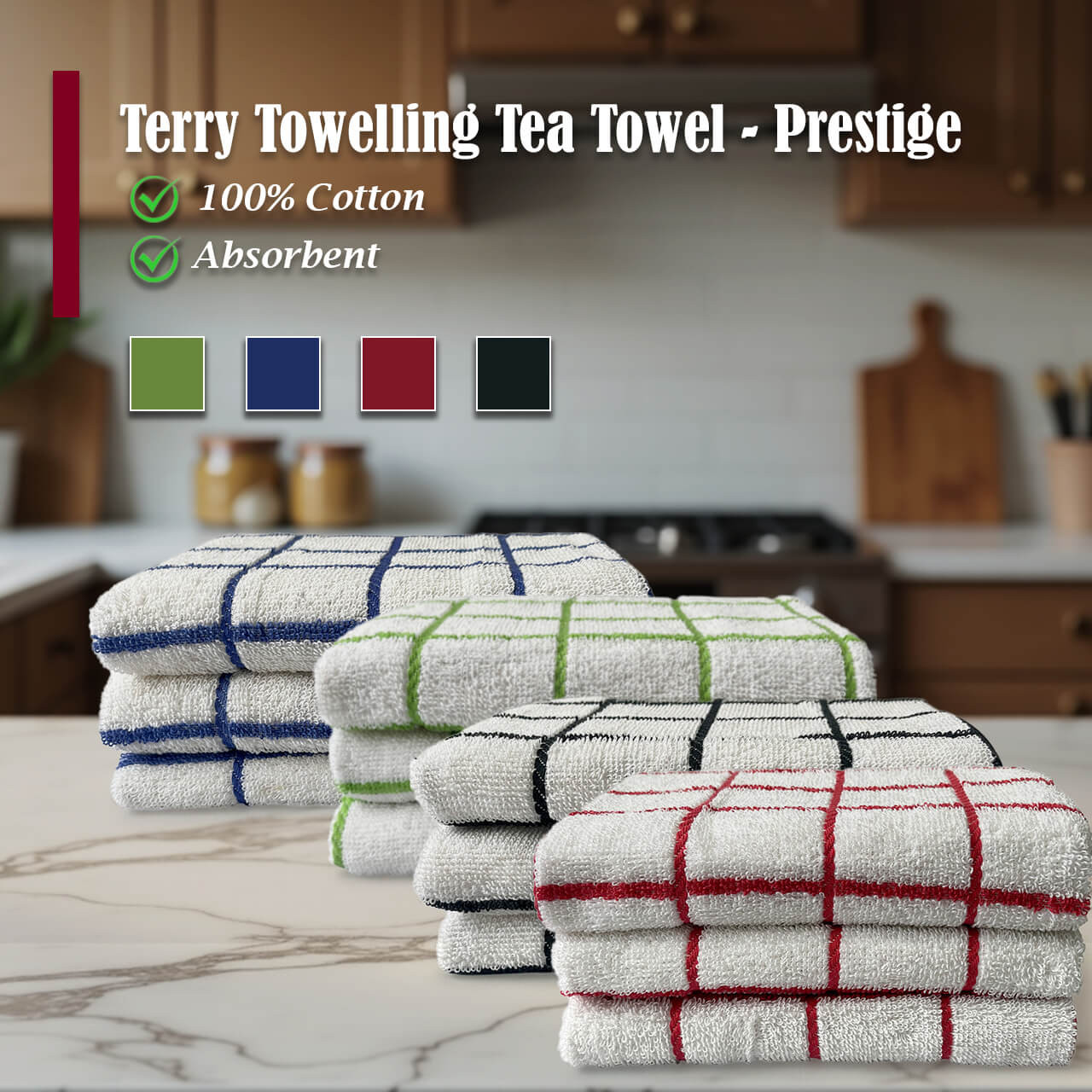
For dishes, pots, pans and general kitchen drying, this matters. You are dealing with water that needs to go somewhere quickly. Terry moves it efficiently.
The trade-off is drying time between uses. The same loops that absorb well also hold onto moisture. In a home kitchen that is rarely a problem — you have several cloths rotating. In a high-volume commercial kitchen running cloths continuously through a service, it is worth factoring into how many you keep in circulation. A damp terry cloth left sitting is also where odour and bacteria build up — which is why frequent laundering at 60°C is essential, not optional, for any kitchen cloth used on food-contact surfaces.
Buying for a commercial kitchen? See how cotton compares to microfibre for professional use.
What Flat Weave Actually Does
Flat weave — wonder dry — has no loops. The cotton fibres are woven tightly together in a smooth, thin construction. It feels almost more like a fabric than a traditional tea towel or kitchen cloth.
The way it absorbs is different too. Rather than pulling moisture through loops, flat weave draws it sideways into the fibres through capillary action. It fills quickly and releases moisture just as fast during drying — which is why flat weave dish towels dry out between uses much faster than terry.
The smooth surface is what makes it genuinely useful for glassware. Wine glasses, beer glasses, barware — anything transparent that will show every smear and lint trace. A terry cloth leaves fine fibres behind on glass. Hold the glass up to the light and it shows. Flat weave does not do this. The surface comes out clean.
This is also why flat weave is the standard glass cloth in hospitality — bars, restaurants and hotels where glassware is inspected before it goes on the table.
Which Material Is Best for Tea Towels?
This is the question most buyers are really asking, and the honest answer is: 100% cotton in either construction, chosen for the right task.
Cotton is the only material worth considering for kitchen cloths and dish towels used in food environments. It handles high-temperature washing at 60°C — the minimum needed to effectively clean kitchen cloths — without degrading. It has natural heat resistance for contact with warm cookware. It improves slightly in absorbency after the first few washes as fibres open up with use.
Cotton-rich blends with polyester content absorb less effectively and degrade faster at commercial wash temperatures. Open-end spun cotton — common in cheap supermarket tea towels — thins significantly within 30–50 washes. Ring-spun cotton, which is tighter and more uniformly twisted, holds its structure and absorbency considerably longer.
The construction question — terry vs flat weave — comes after the material question is settled. Both should be 100% ring-spun cotton. Then the construction choice comes down to the task.
The Best Weave for Kitchen Towels — Task by Task
Terry is better for: Drying plates, pots, pans, baking trays and anything where you need genuine absorbency. Also good for wiping down wet surfaces, drying hands and general kitchen work. Terry tea towels at 200–300 GSM for home kitchens, 300–400 GSM for commercial and high-frequency use.
Flat weave is better for: Glassware, stemware, cutlery polishing and any task where you need a streak-free, lint-free finish. Also better where the cloth needs to dry out quickly between uses — a busy bar or front-of-house team, for example. Wonder dry cotton tea towels at 150–200 GSM for this purpose.
Herringbone is better for: General everyday kitchen tasks where grip and texture are useful alongside absorbency. Handling dishes safely, wiping surfaces, light scrubbing. A good all-rounder for home kitchens that want one cloth type for most tasks.
The mistake most kitchens make — home or commercial — is buying one type and using it for everything. Terry on glasses leaves marks. Flat weave on heavy pots takes more effort. Neither is a bad product. They are built for different jobs.
What Is a Flat Weave Towel? — For Anyone Who Has Seen the Term
A flat weave towel is any towel or cloth where the fibres are woven in a tight, smooth pattern without loops or pile. In kitchen cloths specifically, this means wonder dry construction — tightly woven cotton that is thinner and lighter than terry, faster drying, and better suited to tasks where a smooth surface contact matters.
The term comes up across kitchen towels, bath towels and general textiles. In the kitchen context, flat weave and wonder dry mean the same thing in practice.
GSM and Construction — How They Work Together
GSM measures how heavy and dense the cloth is per square metre. In terry towels, higher GSM means more loops, more thickness, more absorbency. In flat weave, higher GSM means denser fibres — still smooth, but heavier and slightly more absorbent per wipe.
For home kitchens, 200–300 GSM in terry covers most tasks. For commercial kitchens doing serious volume, 300–400 GSM terry for general drying and 150–200 GSM flat weave for glassware is the sensible pairing.
One thing that applies regardless of construction or weight: do not use fabric softener. It coats cotton fibres and reduces absorbency regardless of GSM. A terry cloth treated with softener will feel pleasant but smear rather than absorb. Wash kitchen cloths and dish towels at 40–60°C with standard detergent only.
For a full GSM breakdown, read our tea towel GSM guide.
FAQs
Which material is best for tea towels?
100% ring-spun cotton — in either terry or flat weave construction depending on the task. Cotton handles high-temperature washing, has natural heat resistance and holds its absorbency through repeated laundering better than blended or synthetic alternatives. For dishes and general kitchen drying, terry. For glassware and streak-free work, flat weave.
What is a flat weave towel?
A kitchen cloth woven in a tight, smooth pattern without loops or pile. Also sold as wonder dry in UK trade and commercial settings. Thinner and lighter than terry, faster-drying between uses, and the right choice for glassware and lint-free polishing tasks.
What are terry tea towels used for?
Drying dishes, pots, pans and wet surfaces where absorbency is the priority. Terry towelling is also good for drying hands and wiping down kitchen surfaces. Not the best choice for glassware — the looped construction leaves fine fibres on transparent surfaces that show up as haze or streaks.
What is the best weave for kitchen towels?
Terry for absorbency and heavy-duty drying. Flat weave for glassware and streak-free tasks. Herringbone for everyday versatility and grip. Most well-equipped kitchens — home or commercial — use at least two: terry for the sink, flat weave for the glass shelf. There is no single best weave because the task determines the answer.
Can I use a terry tea towel on wine glasses?
You can, but it is not ideal. Terry cloths leave fine fibres on glass surfaces that show up as smear or haze, particularly on transparent glassware held to the light. For everyday tumblers it rarely matters. For wine glasses, barware or anything guests will inspect, flat weave wonder dry is the better choice.
How many tea towels does a home kitchen need?
Six is a practical number for daily use — enough to rotate without running low between washes. If you cook frequently, eight to ten gives more comfortable coverage. Keep two or three flat weave cloths separate specifically for glassware, and use terry for everything else.
Is wonder dry the same as flat weave?
Yes. Wonder dry is a trade name for flat-woven cotton kitchen cloths. All wonder dry cloths are flat weave — smooth, tight cotton construction, no loops, fast-drying. The construction and performance are the same regardless of what the label says.
Browse the full range of cotton tea towels and kitchen cloths — UK manufactured in Bolton, no minimum order, free delivery on orders over £35.