



Cotton vs Microfibre Hand Towels for Kitchens — Which Actually Works Better?
Posted by Talha Nisar on 30th Jun 2026
The kitchen is the hardest-working room in the house for hand towels. It's not just hand drying — it's wiping surfaces, handling hot things, mopping spills, and doing all of it repeatedly throughout the day. A bathroom hand towel sees two or three uses a day; a kitchen hand towel might see twenty.
The cotton vs microfibre question matters here more than anywhere because the two materials behave completely differently under kitchen conditions. The answer isn't obvious, and it depends on what you're using the towel for — hand drying, surface wiping, or both.
What microfibre actually is
Microfibre is a synthetic material — typically polyester and polyamide blended — where the fibres are split into strands far finer than a human hair. The result is a fabric with enormous surface area relative to its weight. That surface area is what makes microfibre effective: it picks up moisture, grease, and bacteria mechanically, without needing detergent or significant pressure.
Microfibre kitchen cloths and towels are genuinely good at certain specific tasks: wiping glass and smooth surfaces without streaking, picking up grease from worktops, and drying hands quickly when the towel is clean and dry. They're also lightweight and pack down small, which is why they appear in gym bags and travel kits.
The limitations matter for kitchen use. Microfibre cannot be washed above 60°C without the fibres degrading — the synthetic material breaks down faster than cotton at high temperatures. It also picks up and holds lint and pet hair in a way that cotton doesn't, which becomes noticeable quickly in a kitchen environment. And microfibre sheds microplastics with every wash — a consideration for anyone buying on sustainability grounds. Cotton is a natural fibre and biodegradable; microfibre is synthetic and contributes microplastic pollution to waterways every time it's washed.
What cotton does better in a kitchen
Ring-spun cotton at 400–500 GSM handles kitchen conditions better than microfibre across most practical measures for daily hand drying use.
Temperature tolerance is the main advantage. Cotton hand towels at institutional grade handle washing at 60°C and above without degrading — which matters in a kitchen where hygiene is a genuine concern, not just a theoretical one. A hand towel used in a kitchen that prepares raw meat, handles allergens, or serves a large family should be washable at 60°C. Microfibre isn't.
Cotton hand towels also become more absorbent after multiple washes, not less — the fibres open up slightly with each cycle, which increases moisture absorption over time. A ring-spun cotton institutional hand towel at six months of daily use will absorb faster than the same towel on day one. Microfibre works in the opposite direction at kitchen temperatures — repeated washing at 60°C and above gradually degrades the split-fibre structure that makes it effective, reducing its cleaning performance over time.
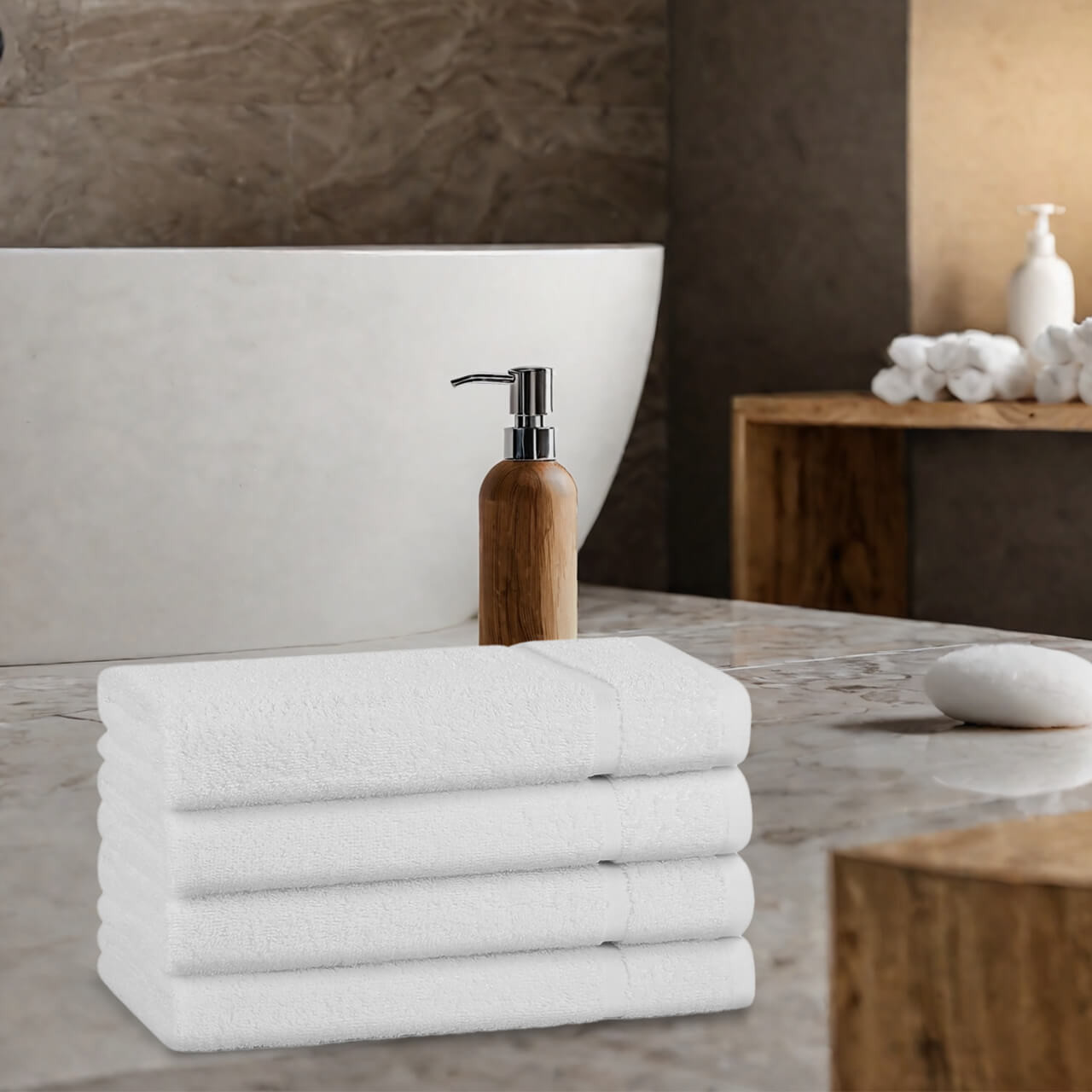
400 GSM Institutional — ring-spun cotton, rated for 60°C, the practical choice for kitchen hand drying
Absorbency for hand drying is the second advantage. Cotton terrycloth — the looped pile structure used in towels — is designed specifically to absorb and hold moisture from skin. Microfibre picks up moisture effectively when it's clean and dry, but saturates faster and recovers more slowly in a kitchen where the towel is being used continuously. A 400 GSM ring-spun cotton hand towel used twenty times in a day will still absorb on use twenty because the cotton pile recovers between uses.
Durability is the third. Ring-spun cotton at institutional grade is designed for commercial laundry cycles — hundreds of washes at high temperatures. Microfibre starts to degrade structurally after repeated high-temperature washing; the fibres lose their splitting and the material becomes less effective at its primary job.
The chlorine resistance question
In professional kitchens and commercial food preparation environments, cleaning products often include chlorine-based sanitisers. Standard cotton hand towels are not chlorine resistant — bleach will degrade the fibres and cause colour loss. Microfibre is similarly vulnerable to chlorine.
If your kitchen cleaning routine involves bleach-based products and the hand towel comes into regular contact with surfaces wiped with those products, the chlorine-resistant 400 GSM black hand towel is the specific answer. It's designed for exactly this environment — gyms and professional kitchens where chlorine sanitisers are standard.
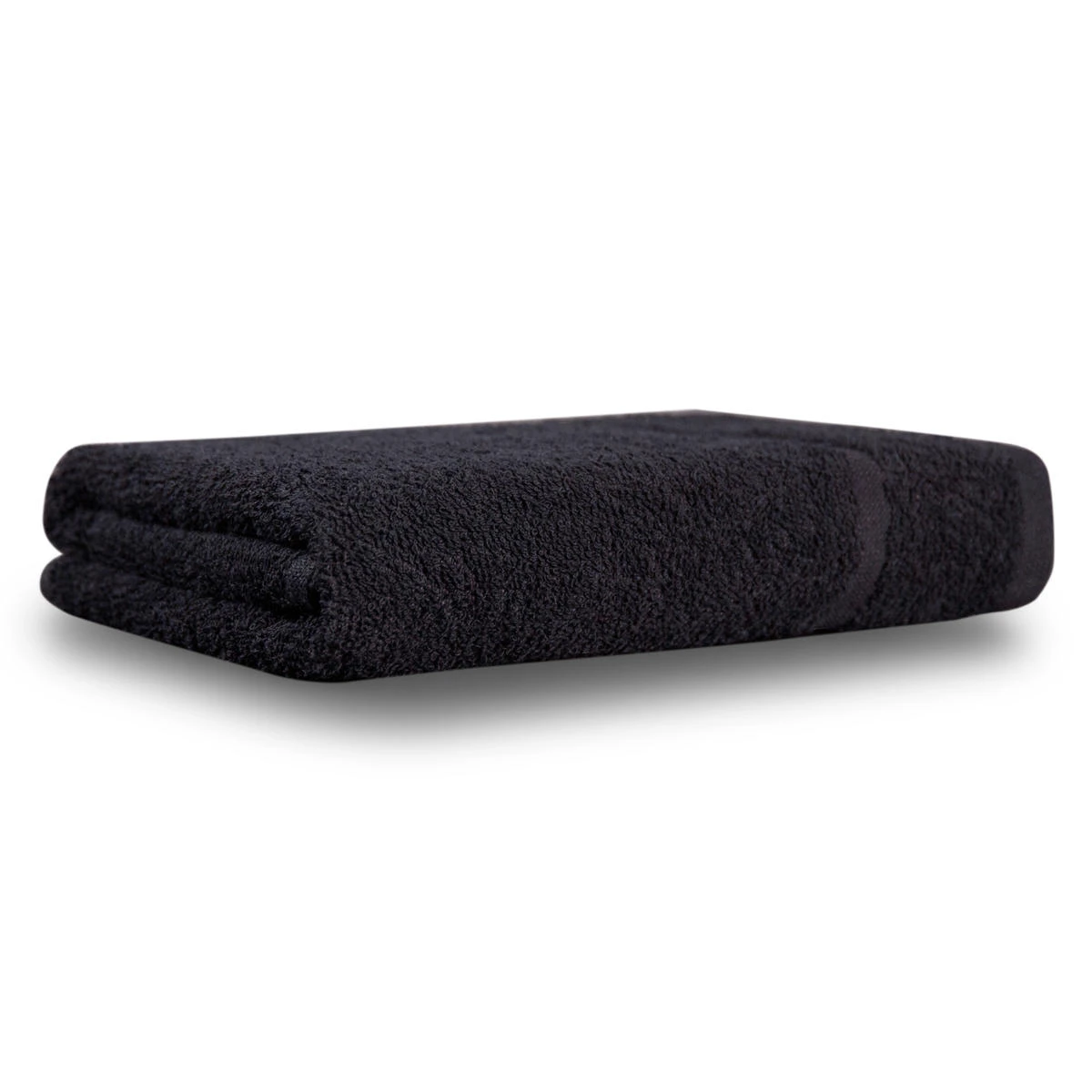
400 GSM Chlorine Resistant — black, for kitchens where bleach-based sanitisers are used
Size — what actually works in a kitchen
A full 50 x 90 cm hand towel on a kitchen rail or hook works well and is the most practical format for hand drying. Some buyers find it too large for a small kitchen hook — in which case the 30 x 50 cm guest towel format dries hands effectively and takes up less space. It can be folded in half and hung on a standard hook without bunching.
The sweat towel format — 30 x 90 cm — is also used in kitchens as a combined hand-drying and surface-wiping cloth. It's not technically a hand towel but fills the same function in some kitchen setups, particularly in professional kitchens where chefs carry a service cloth.
When microfibre is the right choice for kitchens
Microfibre is the right choice for specific kitchen tasks — not general kitchen hand towel use. Cleaning glass splashbacks and windows without streaking: microfibre outperforms cotton. Wiping stainless steel appliances: microfibre. Dusting surfaces: microfibre. Picking up fine grease from smooth surfaces: microfibre.
One important limitation of cotton for surface work: cotton hand towels shed lint on glass and polished stainless steel surfaces. If you wipe a glass splashback or a mirror with a cotton hand towel, it will leave fibres. Microfibre is lint-free on smooth surfaces, which is why it's the better tool for glass and appliance cleaning specifically. This is a genuine functional difference — not a reason to replace cotton for hand drying, but a reason to keep a dedicated microfibre cloth for glassware and polished surfaces alongside the cotton hand towel for everything else.
For these tasks, microfibre is genuinely better than cotton. Keep a dedicated microfibre cloth for surface cleaning tasks and a cotton hand towel for hand drying. Using the same towel for both creates cross-contamination risk and means neither material is doing the job it's best suited to.
The honest comparison for kitchen hand drying
For hand drying specifically, ring-spun cotton wins on every practical measure that matters in a kitchen: wash temperature tolerance, absorbency under repeated use, durability through commercial washing, and resistance to the conditions of a kitchen environment. The 400–500 GSM institutional range is priced for volume use — it's not expensive to maintain a stock of three or four and rotate them.
Microfibre wins on specific surface cleaning tasks and on pack size for travel or gym use. In a kitchen, it belongs next to the cotton hand towel, not instead of it.
No minimum order. Free delivery over £35. Browse kitchen-suitable hand towels
FAQs
Are cotton or microfibre hand towels better for kitchen use?
Cotton for hand drying — it handles high-temperature washing, recovers faster between uses, and is more durable through repeated daily use. Microfibre for surface cleaning tasks — glass, stainless steel, smooth surfaces where streak-free results matter. Using both for their respective purposes is better than choosing one for everything.
Can I wash kitchen hand towels at 60°C?
Ring-spun cotton institutional hand towels are rated for 60°C and above. Microfibre should not be washed above 60°C repeatedly — the synthetic fibres degrade and the material loses effectiveness. If kitchen hygiene requires high-temperature washing, cotton is the only practical choice.
What size hand towel is best for kitchen use?
50 x 90 cm is the standard and works well on most kitchen rails or hooks. For smaller kitchens or compact hooks, the 30 x 50 cm guest towel format dries hands effectively and takes up less space. Avoid using bath towels in a kitchen — they're too large and dry too slowly between uses.
Do microfibre kitchen towels harbour more bacteria than cotton?
Both accumulate bacteria when damp and used repeatedly — the material isn't the determining factor, washing frequency and temperature are. Cotton can be washed at 60°C or above, which eliminates kitchen bacteria effectively. Microfibre shouldn't be washed above 60°C repeatedly without degrading. For a kitchen where hygiene is a priority — food preparation, allergen handling — cotton washed daily at 60°C is the more reliably hygienic choice. The 700 GSM GOTS certified bamboo hand towels are naturally antibacterial at fibre level, which reduces bacterial growth between washes, though regular washing is still required.
How often should kitchen hand towels be washed?
Daily in a busy kitchen is the practical standard. A kitchen hand towel used twenty or more times a day picks up bacteria, grease, and food residue that accumulate quickly. Ring-spun cotton at institutional grade handles daily washing at 60°C without degrading — which is the construction specifically designed for this level of use. If daily washing isn't practical, maintain a rotation of three or four towels so a fresh one is always available.
Do cotton hand towels harbour bacteria?
Any damp towel used repeatedly will accumulate bacteria — cotton or microfibre. The hygiene solution is washing frequency and temperature, not material choice. Cotton washed at 60°C eliminates the bacteria that accumulate in kitchen use. Microfibre at the same temperature is effective but the material degrades faster with repeated high-temperature washing.
Are there towels that combine cotton and microfibre for kitchen use?
Cotton-microfibre blend kitchen towels exist — typically a cotton-rich face with a microfibre backing or a woven blend of both fibres. They aim to combine cotton's heat tolerance with microfibre's quick-drying properties. The practical trade-off: they can't be washed at as high a temperature as 100% cotton, and they don't perform either function quite as well as a dedicated material. For most home kitchens, two separate towels — a ring-spun cotton hand towel for hand drying and a dedicated microfibre cloth for surface cleaning — is a more effective setup than a single compromise product. Browse cotton hand towels for kitchen use
What's the most cost-effective hand towel for kitchen use?
The 400 GSM 100% cotton institutional hand towels — ring-spun, not open-end — are the lowest price point that handles kitchen conditions properly. Open-end cotton at similar GSM is cheaper per unit at purchase but degrades faster under daily use and frequent high-temperature washing, making the annual replacement cost higher. Ring-spun at 400 GSM is the starting point worth buying. Browse 400 GSM Institutional Hand Towels
Related reading: Why hand towels go hard after washing · Best hand towels for bathrooms UK — GSM guide · Hand towel sizes UK — dimensions and GSM guide · Browse hand towels